


Italian Liberty: Architecture in Bloom

At the dawn of the 20th century, Italy was ready for a new visual language. Known internationally as Art Nouveau, in Italy this movement became Liberty: an architecture that rejected rigid academic traditions in favour of movement, nature, craftsmanship and imagination.
From Turin and Milan to Palermo, Catania and Naples, and from the lakes of Lombardy to the Adriatic coast, Liberty transformed the Italian cityscape. Buildings were no longer conceived simply as structures. Their façades became works of art.
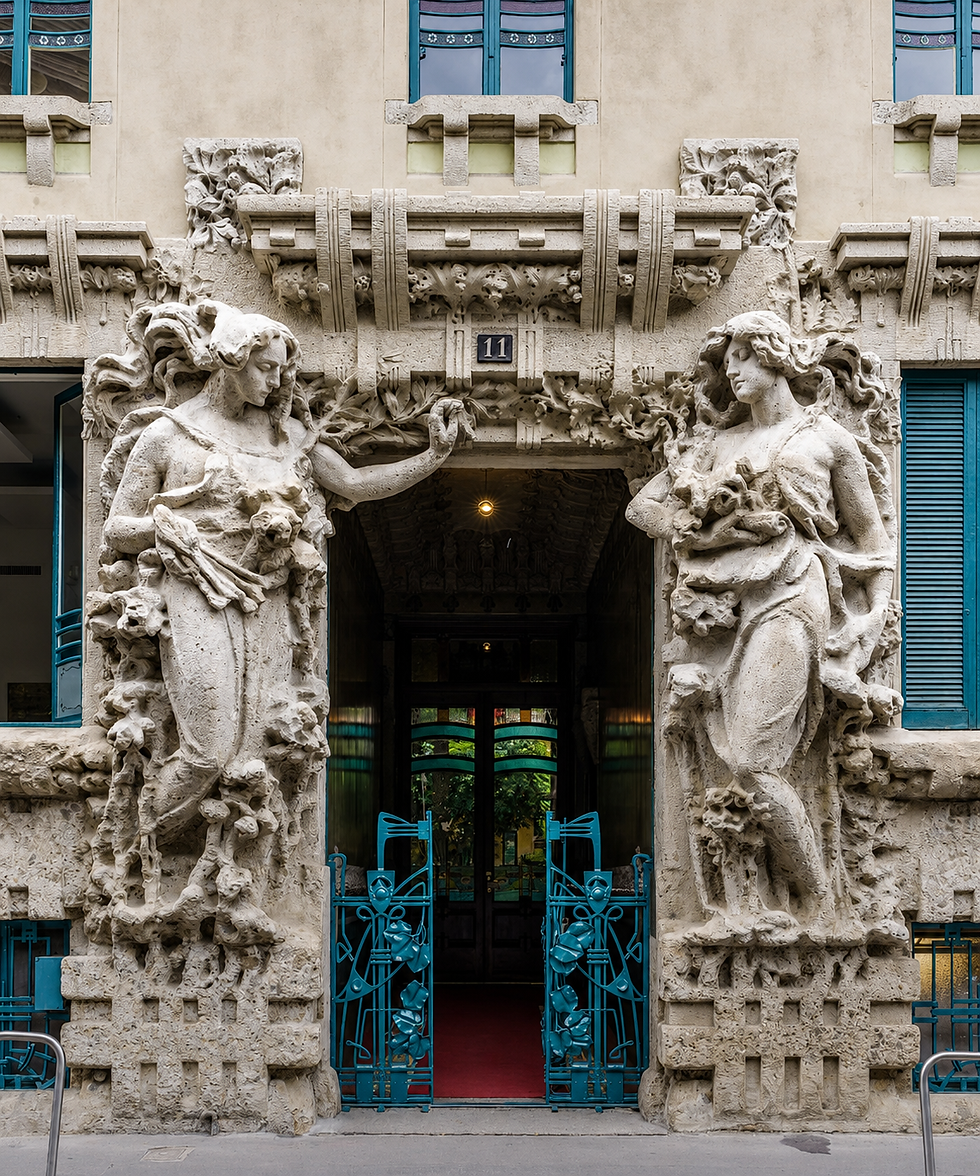
Flowers climb across walls. Wrought-iron balconies twist like vines. Female figures emerge from stone. Stained glass, ceramics, mosaics and sculpted concrete bring colour and texture to windows and entrances. Even functional details become decorative.
Yet Italian Liberty was never a single, uniform style. Some architects embraced flowing floral forms; others mixed Art Nouveau with medieval towers, Renaissance references or exotic influences. That variety is precisely what makes these buildings so fascinating.
The movement flourished particularly around the turn of the century, with the 1902 Turin International Exhibition becoming one of its defining moments. Architects and designers sought to unite architecture, decorative arts and craftsmanship into a complete artistic experience.
By the 1920s, tastes were changing. Art Déco, Rationalism and the avant-garde introduced cleaner, more geometric forms. Liberty gradually disappeared from the architectural mainstream.
But its buildings remain.
More than a century later, scattered across Italy, these extraordinary villas and palazzi still capture the optimism of an era that believed everyday life could—and should—be surrounded by beauty.
Italian Liberty was more than a style. It was architecture learning to bloom.





Comments